
JH Solar Products: Version 1 vs Version 2 Compared
Last checked · JH Solar guide

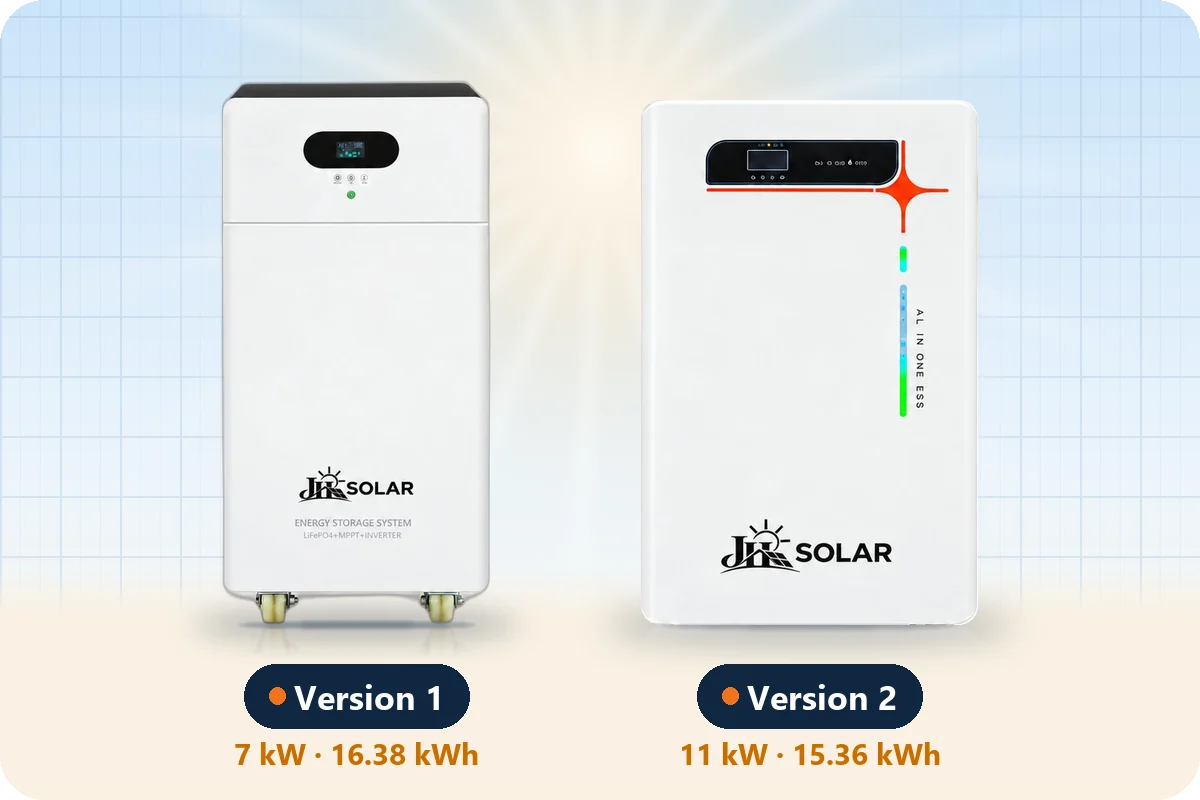
JH Solar products come in two versions: Version 1 and Version 2. Both are full-size all-in-one solar units, with the hybrid inverter, the solar charger and a LiFePO4 battery in one floor-standing cabinet. This page puts them side by side, with specs, unit prices and a simple guide to which one fits which home.
Each unit also has its own page with full details, wiring, examples and customer reviews. Read on to narrow it down, then open the page of the one that fits.
JH Solar Products at a Glance
In one line each: JH Solar Version 1 is the 7 kW, 16.38 kWh unit with the bigger battery and the lower price, for strong night and brownout backup in most grid-connected homes, and JH Solar Version 2 is the 11 kW, 15.36 kWh unit with two solar inputs for more daytime solar, several aircon units at once and off-grid homes.
- Version 1 · ₱120,000 unit7 kW inverter, 16.38 kWh battery, one solar input for up to 6 panels. The bigger battery, for nights and brownouts at a lower price.
- Version 2 · ₱150,000 unit11 kW inverter, 15.36 kWh battery, two solar inputs for 14 to 16 panels. Made for aircon and daytime loads.
Both JH Solar products share the same idea, so the choice comes down to how much solar you want to collect and how much power you draw at once. The battery sizes are almost the same; the solar input and the inverter are not.
JH Solar Products Compared: Specs and Unit Prices
Here are the rated figures for both JH Solar products in one table. Prices are for the unit only; the setup around it is quoted after a site assessment.
| Item | Version 1 | Version 2 |
|---|---|---|
| Unit price | ||
| Inverter output | 7 kW, 230 V AC, pure sine wave | 11 kW, 230 V AC, 60 Hz, pure sine wave |
| Rated AC output current | about 30.4 A | about 47.8 A |
| Battery (nominal) | 16.38 kWh, 51.2 V, 320 Ah | 15.36 kWh, 51.2 V, 300 Ah |
| Battery chemistry | LiFePO4 | LiFePO4 |
| Solar inputs (MPPT) | 1, 4,480 W max | 2, 5,500 W max each |
| MPPT voltage window | 60–140 V | 120–500 V |
| Max PV open-circuit voltage | 180 V | 500 V |
| Max solar charging current | 80 A | 160 A |
| Package panels | 6 × 620 W = 3.72 kWp | 14 × 720 W = 10.08 kWp |
| Largest practical arrays | 6 × 620 W = 3.72 kWp; 6 × 720 W = 4.32 kWp | 14 × 720 W = 10.08 kWp (7 + 7 per MPPT); 16 × 620 W = 9.92 kWp (8 + 8 per MPPT) |
| Battery management | Confirmed with your quote | BMS up to 200 A; at least 8,000 cycles to 80% (lab conditions) |
| Size and weight | Confirmed with your quote; on casters | 57 × 40 × 78 cm (W × D × H), about 160 kg, on casters |
| Grid | Works with or without grid power | Off-grid capable: runs with or without grid power |
| Warranty | Warranty terms are written into your quote | 10-year hardware warranty; exact coverage is written into your quote |
| Example sunny-day solar output | ≈ 11.2 kWh | ≈ 30.2 kWh |
Unit only; panels, mounting, wiring, labor and permits are quoted after a site assessment. Example output = array kWp × 4 peak sun hours × 0.75 overall factor; your roof, shade and season change the real figure.
Which of the JH Solar Products Fits Which Home
Choosing between the two JH Solar products starts with the kWh on your bill and what you want running during a brownout. The fastest way is to put your bill through our solar computation tool, then use the table below to see which way your answers lean.
| Your situation | Leans toward Version 1 | Leans toward Version 2 |
|---|---|---|
| Main goal | Night and brownout backup | Lower daytime bill plus backup |
| Aircon | One or two inverter units, with everything running at once under about 5.6 kW | Several units at once, or more than about 5.6 kW together |
| Monthly use | With the grid: up to roughly 500–550 kWh a month | Off-grid above about 300 kWh a month, or the most bill savings |
| Daytime solar (example) | What 6 panels make (≈ 11.2 kWh on a sunny day); the grid covers the rest | Up to what 14 panels make (≈ 30.2 kWh) |
| Roof space | Room for about 6 panels | Room for 14 to 16 panels |
| Roof faces | One good roof face is enough | Two faces (east and west) suit the two inputs |
| Floor space | A dry, ventilated spot near the panel board | A solid, level floor for about 160 kg |
| Unit budget | ₱120,000 | ₱150,000 |
A guide only. The site assessment checks your actual roof, wiring and loads before we suggest a unit.
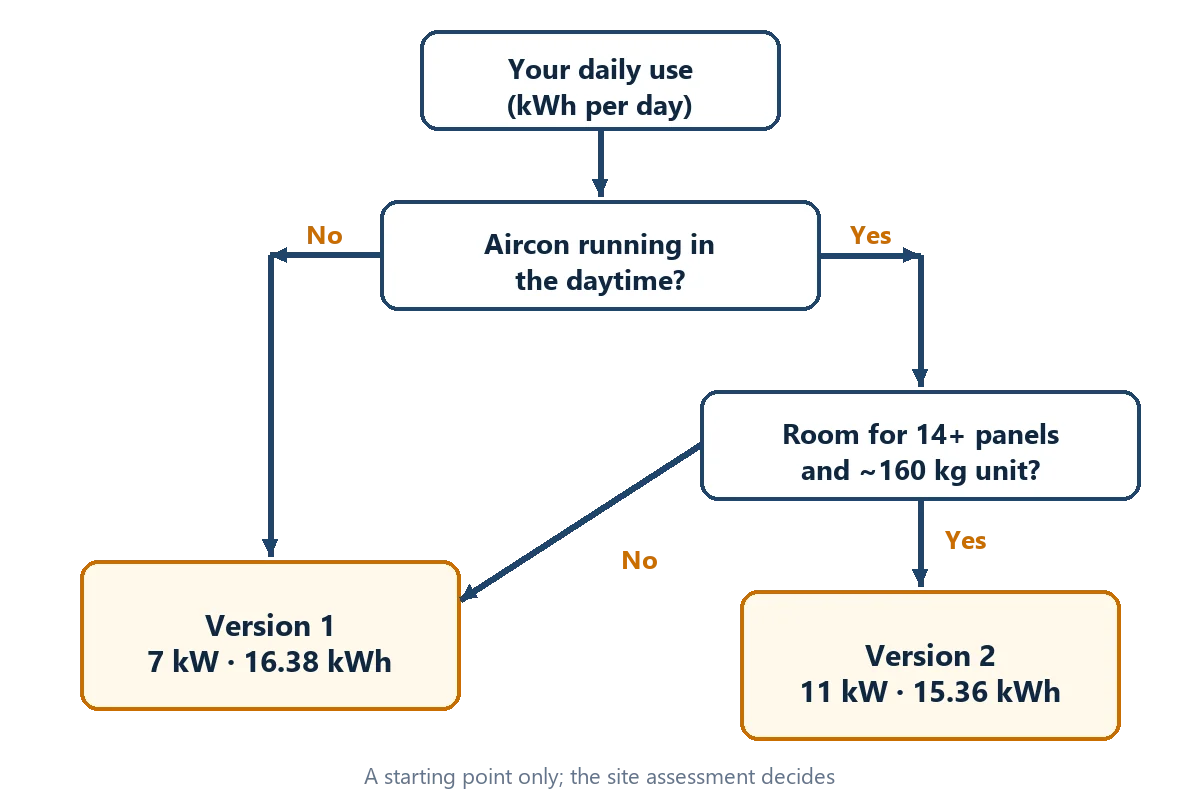
Two example households make it concrete. Example A: a family on Meralco using about 400 kWh a month, with a fridge, fans, lights, Wi-Fi and one aircon at night. Version 1 carries the nights and brownouts from its bigger battery, and the grid fills the daytime gap its six panels leave. Example B: a family with two aircon units in the afternoon and one at night. Version 2 fits better, because the daytime aircon load needs the bigger array.
Think a few years ahead, too. If you plan to add an aircon, a second refrigerator or a home business, size for that now. The single input of Version 1 cannot grow past six panels, while Version 2 leaves room for up to 16.
What Both JH Solar Products Share
A typical home battery system has separate boxes on the wall: a hybrid inverter, battery packs, and the cables and breakers between them. Both JH Solar products put the inverter, the lithium iron phosphate battery and the solar charger in one cabinet instead.
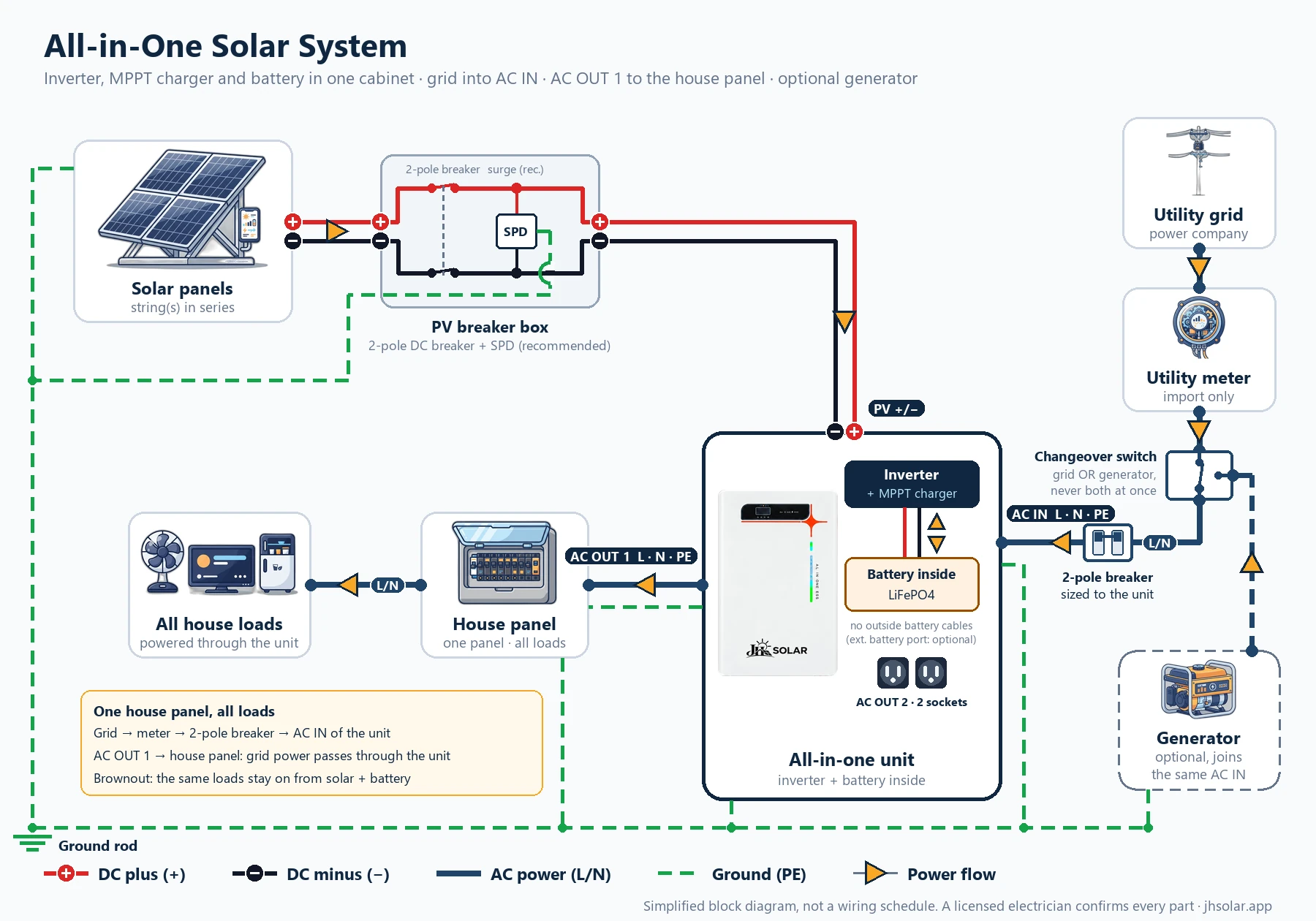
Solar panels connect through a 2-pole DC breaker, with a recommended surge protector, to an all-in-one unit that holds the inverter, the MPPT charger and the battery in one cabinet. Utility power comes through the import-only meter and one 2-pole breaker into the unit’s AC IN. Its AC OUT 1 feeds the one house panel with all the loads, and AC OUT 2 is two sockets on the unit. An optional generator joins the same AC IN through a changeover switch. The panel frames, the unit and the house panel bond to a grounding rod.
- One cabinet: no external battery cables, less wall space, and parts already matched.
- Same battery voltage: both use a 51.2 V LiFePO4 battery, a chemistry that handles deep daily cycling better than lead-acid.
- Pure sine wave 230 V output: clean power for fridges, aircon, TVs and electronics.
- One house panel: grid power passes through the unit to your house panel. In a Meralco or cooperative brownout, the unit runs the same loads from solar and battery, switching in about 10 ms.
- Import only: the unit draws from the grid but never exports, so net metering does not apply.
- Plug-and-play, and movable: both are floor-standing units that can be moved, the step up from a hand-carry power station.
The trade-off of any all-in-one design is flexibility: the inverter and battery are serviced together. If you are still deciding between a portable unit and an installed one, our guide to power stations with solar panels shows where each one fits. For the general layout of a home system, the overview of photovoltaic systems is a useful read.
The Three Differences That Matter
1. Solar input
Version 1 has one MPPT input rated 4,480 W, with at most three panels per string because of its 180 V limit, so six panels in a 3S2P layout. Version 2 has two MPPT inputs rated 5,500 W each, 11,000 W in total, for 14 × 720 W or 16 × 620 W panels. This is the biggest gap between the two.
2. Inverter power
The inverter decides how much can run at the same moment. Version 1 delivers 7 kW and Version 2 delivers 11 kW. Your whole house panel runs through the unit, so in a brownout everything switched on at once must stay within that rating. Two aircon units plus a water pump is where Version 2’s headroom matters.
3. Battery refill speed
The batteries are close in size. Example: 16.38 kWh × 0.9 × 0.95 ≈ 14.00 kWh for Version 1, and 15.36 kWh × 0.9 × 0.95 ≈ 13.13 kWh for Version 2 reach your appliances. What differs is how fast the sun puts it back: Version 1 charges at up to 80 A, Version 2 at up to 160 A. A Version 1 battery drained overnight often will not be full by sunset; a Version 2 battery usually has a better chance on a sunny day.
What a Full Setup Includes
The unit prices of JH Solar products cover the cabinet only. A working system needs these parts, and each is listed in your written quote:
- All-in-one unit (hybrid inverter and battery in one cabinet)
- Solar panels
- Mounting rails and roof hardware
- Electrical parts: PV cables, DC isolators and breakers, surge protection, AC breaker, grounding
- Labor: installation and commissioning
For each of the JH Solar products, the unit price buys the finished cabinet: inverter, solar charger and battery, already joined and tested together. That is ₱120,000 for Version 1 and ₱150,000 for Version 2. Everything outside the cabinet is site work, and that part is where two homes buying the same unit can end up with different totals.
Roof type, the distance from the roof to the cabinet, mounting for local wind and permit fees all change the cost of the same unit, which is why we quote the rest after a site assessment. To see how a full system quote is built and compared, read our solar panel price guide for the Philippines. If an item you expected is missing, such as surge protection or grounding, ask before you sign. A list of the component models in your quote is available too; just ask.
How the Panel Count Is Chosen
For both JH Solar products, the package panel count is a starting point: 6 for Version 1 and 14 for Version 2. The final number comes from your goal, the unit’s input limits and your roof.
| Step | What we check | Version 1 limit | Version 2 limit |
|---|---|---|---|
| 1. Your goal | Night backup, full recharge, or recharge plus daytime loads | Night backup; daytime use beyond 6 panels comes from the grid | Any of the three |
| 2. Panel watts needed | Example: target watts ÷ 0.8 for a 3-hour peak with 20% losses | Capped by the 4,480 W input | Up to 5,500 W per input |
| 3. String voltage | Panels in series must stay inside the MPPT window and under the max voltage | Max 3 per string (180 V) | At least 3 per string (120 V) |
| 4. Whole panels | Round up to whole panels, then split into strings | 6 panels as 3S2P | 7 + 7 × 720 W or 8 + 8 × 620 W |
| 5. Your roof | Space, shade, roof direction and wind exposure | Room for 6 | Room for 14 to 16 |
Example: to charge at about 4,000 W, 4,000 ÷ 0.8 = 5,000 Wp, which is 8 × 620 W or 7 × 720 W on Version 2. Each unit's page has the full examples.
Any change after the site assessment is written into the quote with the reason, so you do not pay for panels that cannot perform on your roof.
Placement for Either Unit
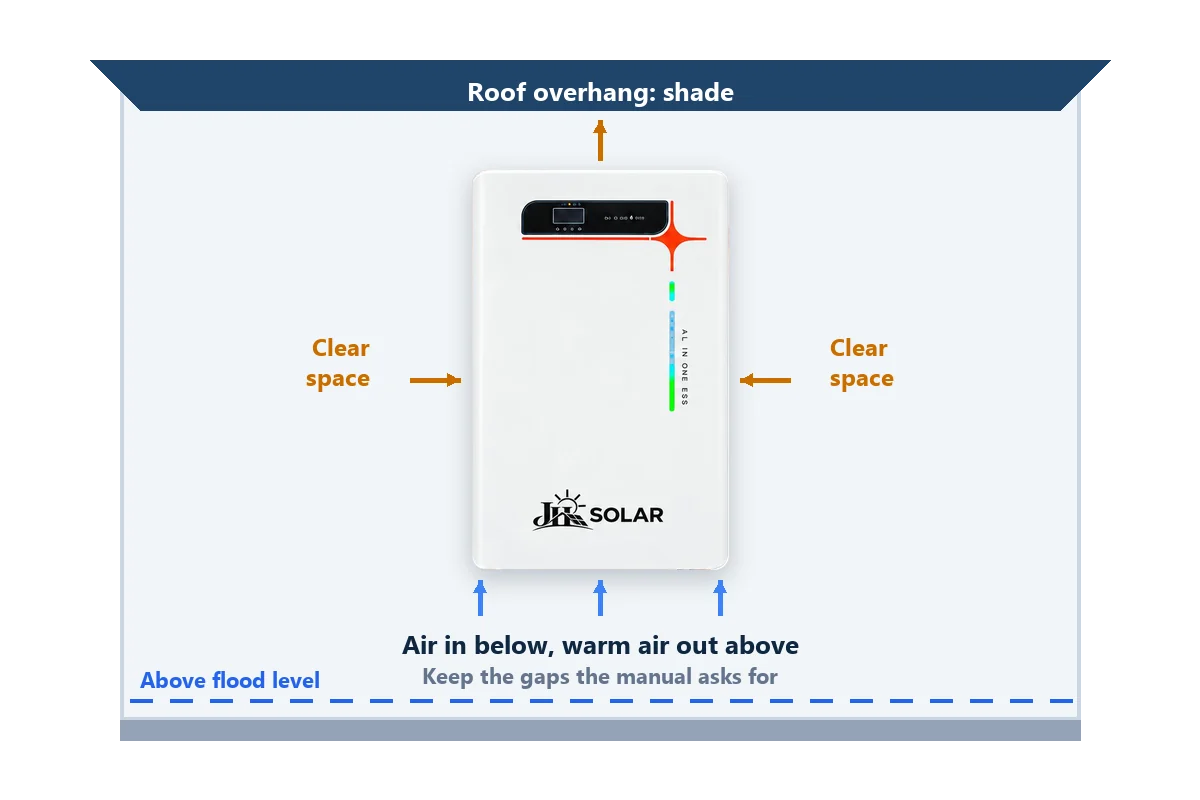
Batteries and inverters last longer when they stay cool and dry. Pick the spot with your installer during the site assessment.
- Shaded, dry and ventilated, out of direct afternoon sun, with open space around the cabinet.
- Above the highest flood level your street has seen.
- Away from LPG tanks, the kitchen, fuel, paint and anything that burns easily.
- On a solid, level floor; both units stand on casters, and Version 2 weighs about 160 kg.
- Reasonably close to the panel board, to limit cable runs.
Philippine Conditions and Tips on Your Phone
Peak sun hours in the Philippines are typically about 3.5 to 5 a day depending on place and season; look up your own city on the Global Solar Atlas. The rainy season lowers output for weeks at a time, and that hits a six-panel array harder than a 14-panel one.
Typhoons are a real design load. PAGASA issues tropical cyclone wind signals, and the roof mounting for either unit must suit the wind in your area. Electricity rates also change monthly, so we size from the kWh on your bill, not the peso total.
On your phone
- Before you photograph your bill, hide your name, address and Customer Account Number (CAN), and keep the kWh line readable.
- Take roof photos from the ground in daylight, and one of the spot where the cabinet could go.
- Photograph the label of each aircon that may run at the same time.
- Keep the quote and warranty terms in one folder on your phone.
How to Order JH Solar Products
Ordering either of the JH Solar products follows the same steps. Nothing is final until you accept a written quote.
Step 1: Compute your needs
Use the solar computation tool with your bill to see your daily kWh and which unit it points to.
Step 2: Send your bill
Hide your name, address and Customer Account Number (CAN) before you take the photo; we only need the kWh used, the billing period and the amount. Then send the bill photo, your city or barangay and the appliances you run at the same time, through the form on our contact page or on Messenger.
Step 3: Site assessment
We check the roof, shade, the spot for the cabinet, the distance to your panel board and your wiring.
Step 4: Written quote
You get the unit, panel count, parts list, price and warranty terms in writing. Ask anything first.
Step 5: Installation
Licensed electricians install the panels, protection devices and unit, test it, and show you how it works.
The contact page for quotes and site assessments lists what to send and what happens next.
Payments and Warranty
Payment methods we accept: Bank transfer, GCash, Maya, Cash. The payment terms for your order are written into your quote, so you know what is due and when before you pay.
Warranty differs by unit. Version 2 has a 10-year hardware warranty, with the exact coverage written into your quote. For Version 1, the warranty terms are written into your quote. Ask what is covered and how a claim works before you sign.
Safety and Electrical Reminders
- Do not open either cabinet. The battery stays live even when the grid is off.
- The panels make DC voltage whenever light hits them. Never unplug panel connectors; service starts with the shutdown steps and the DC isolator switched off.
- Connection to your panel board must be done by a registered master electrician or professional electrical engineer under the Philippine Electrical Code.
- Keep the cabinet ventilated, dry and away from LPG and flammable items.
- After a typhoon or flood, do not touch wet equipment or stand in water near it. Have the unit checked by a licensed electrician before it is restarted.
Solar panels make DC power whenever light hits them, and batteries hold enough energy to start a fire if they are shorted. Work on the grid side, the AC panel board or a net-metered system belongs to a licensed electrical practitioner following the Philippine Electrical Code. Our numbers are estimates, not a design or a quote.
Frequently Asked Questions
Why does Version 1 have a bigger battery than Version 2 at a lower price?
Version 1 is rated 16.38 kWh and Version 2 is rated 15.36 kWh, so Version 1 stores a little more. The two are built for different jobs, not different home sizes. Version 2 costs more because of the rest: an 11 kW inverter instead of 7 kW, and two solar inputs for up to 16 panels instead of one input that takes six. That means Version 2 collects far more daytime solar and runs more loads at once, while Version 1 puts its value into the battery.
What do I get for the ₱30,000 difference between the two units?
The difference between ₱120,000 and ₱150,000 buys a 4 kW larger inverter, a second MPPT solar input, room for 14 to 16 panels instead of 6, a BMS rated up to 200 A, and a 10-year hardware warranty with coverage written into your quote. Version 1 keeps the slightly bigger battery. Whether the extra is worth it depends on your loads: a grid-connected home that mainly wants night and brownout backup may never need the extra solar input.
Which JH Solar unit suits a sari-sari store or small shop?
Look at what runs during store hours. A store with lights, a chiller and a phone charger that mainly needs outage backup can often work with Version 1. A shop with a freezer, several chillers, computers or an aircon running all day leans toward Version 2, since its larger array can carry those loads in the daytime. Send us your bill and a list of equipment to check.
Do both units use the same solar panels?
They can use the same panel sizes, but in different numbers and layouts. Version 1 takes six panels, 620 W or 720 W, as two strings of three. Version 2 takes 14 × 720 W panels as two strings of seven, or up to 16 × 620 W as two strings of eight. The 720 W panel data is confirmed with your quote, and the site assessment sets the final count.
Which payment methods can I use when I order a unit?
We accept bank transfer, GCash, Maya and cash. The payment terms for your order are written into your quote, so you can read them before you pay anything. Keep every receipt and the signed quote together in one folder for the warranty.
What if my electric bill falls between the two sizes?
Then your goal decides. If you mainly want the fridge, lights and fans on during brownouts, Version 1 may cover it at a lower unit price. If you want solar to lower a daytime bill or to run aircon in the afternoon, Version 2 has the solar input for it. Our site assessment checks your roof and loads, and the written quote shows the reasoning.
Conclusion: Choosing Between the JH Solar Products
Both JH Solar products are all-in-one units with a LiFePO4 battery of about the same size. Choose Version 1 at ₱120,000 for the bigger battery at the lower price: strong night and brownout backup for most grid-connected homes, with room for up to six panels. Choose Version 2 at ₱150,000 when you want solar to carry aircon and daytime loads with 14 to 16 panels, run several aircon units at once, or live off-grid.
Prices are for the unit only, and the rest is quoted after a site assessment. Start with your bill, then send it to us. You can also learn more about JH Solar and our guides on the homepage.
Find out which unit fits your home
Compute your daily kWh from your bill, then send it to us for a site assessment and a written quote.
Related Guides
- JH Solar HomeStart here: JH Solar systems and every guide on one page.
- JH Solar Version 17 kW and the bigger 16.38 kWh battery, at a lower price.
- JH Solar Version 211 kW and dual MPPT for more solar and aircon use.
- Solar ComputationTurn your electric bill into a system size in a few taps.
- Contact JH SolarAsk for a quote or a site assessment.
- Power Station With Solar PanelPortable power stations vs a whole-home system.